3 May. 14h42.
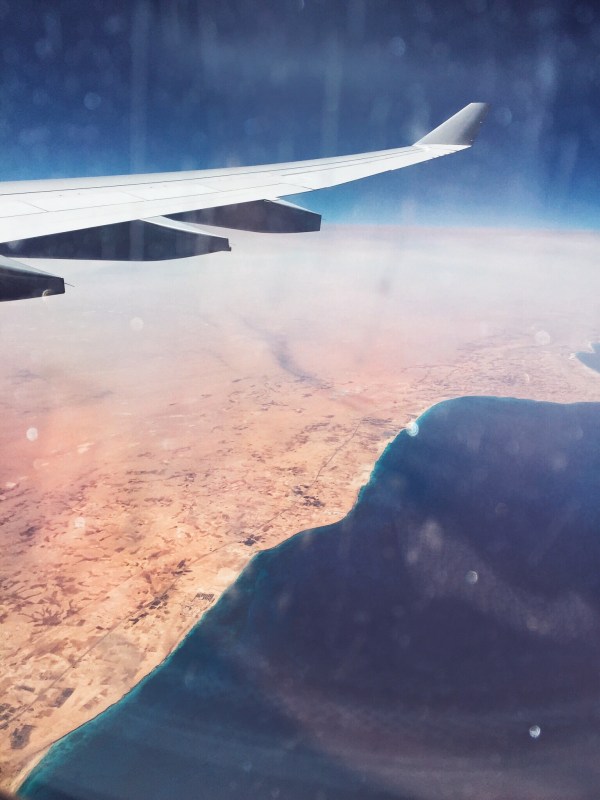
This is Africa. Tunisia, or possibly the northern coast of Egypt, but I have never set foot in these places and when you are flying so many kilometres above a place the borders blend and fade and the countries become one. This is Africa.
The best thing, I find, is when you happen to look up: something catches your eye, from the fringes of a fitful drowse in stale, parched air. And you glance up quite suddenly and see this. Africa. I did not watch the ocean turn away from the silver pale sparkling blue of the Mediterranean – I did not watch it deepen and darken into this throbbing azure below me – but I looked now and I felt the breath leave my lungs and I shook my head in wonder. Africa.
We flew a little farther. This time I watched: the land hardens, begins to drift like a lazy compass needle from the pale yellow of a faded marble into marigold, sienna, burnt orange. Still – unutterably still – foreign, and yet familiar – For an instant I had a glimpse of what Yuri Gagarin must have felt as he looked down on the little blue orb, when he was alone and suspended in nothingness. I tried to imagine the heat rising from it, up through the kilometres of space and time, and I thought of my friend Liam, and a mountain buried deep in the French Alps, far, far away. We sit on the top of this mountain and Liam points to the tips of the snowdrifts, look, he says, see how they are orange? I look and the wind that bites my cheeks is cold and the snow is packed hard beneath me, and it is true: they are dusted ever so slightly in orange. That’s sand blown here from the Sahara.
Neither of us say anything, for a while. He is a boy of the rolling curves of Ontario; I was born in the shadows of the rainforest mountains of the West Coast. In these places we come from, the Sahara desert and the French Alps are pictures in National Geographic magazines – and here they are, sifting through our fingertips. We sit there and we look at this sand for a while, swept so far from home and now stark against the snow in its foreignness, and we grin at each other and shake our heads. There are no words to express this wonderment and this joy.
Now fifteen months have passed so many kilometres ago, and I fly over the sands of the Sahara, and I look down on them and I think of my friend Liam and that mountain buried deep in the French Alps, and I shake my head and grin again. I think, life is a pretty damned strange and wonderful thing.
4 May. 11h17.
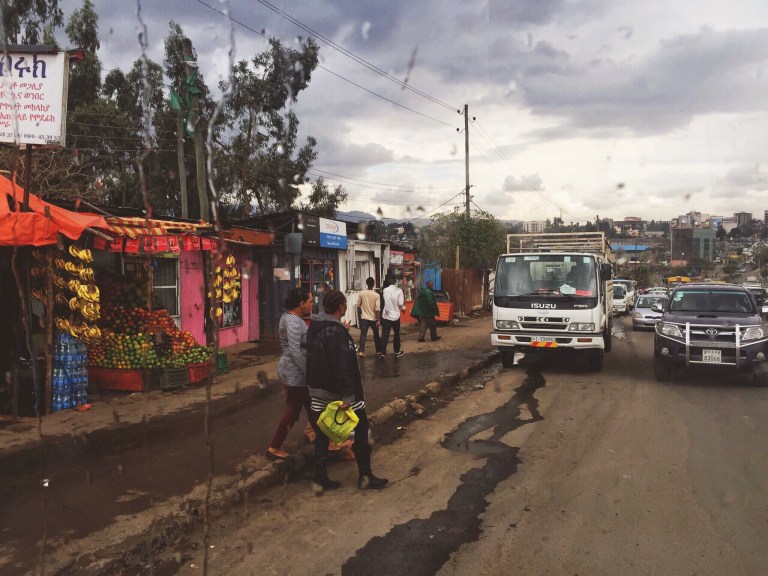
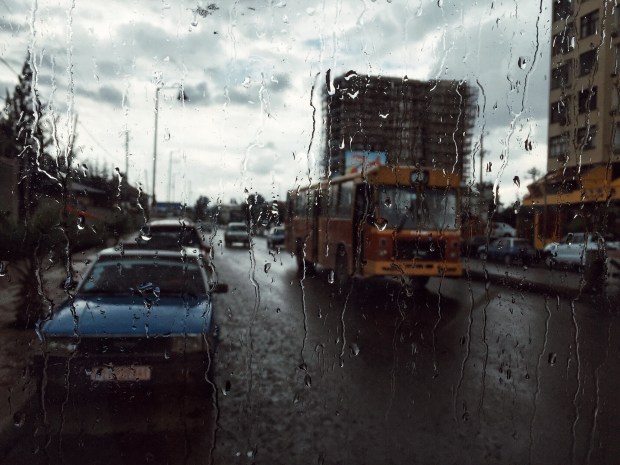
The air is hot but not as hot as you’d expect – it is the beginning of May, after all, and the rainy season arrives in a few short weeks. Instead it is the pollution that stifles, the thick and heavy blanket of taupe-coloured smog and dust that permeates everything. Every city’s got a rhythm but Addis Ababa has none. Addis is a city totally devoid of logic. Athena was born from the forehead of her father Zeus and so Addis, this tumbling, tumultuous tempest, was born from the vision of the Emperor Menelik II in the late 1880s. You can tell, I think. You can feel the inorganic nature of this metropolis in the total chaos of its traffic, in the evidence of globalization which has this developing city in its beast-like jaws: soaring piles of rubble, torn-up sidewalks, unnerving skeletal toothpick scaffolding draping every half-constructed hotel.
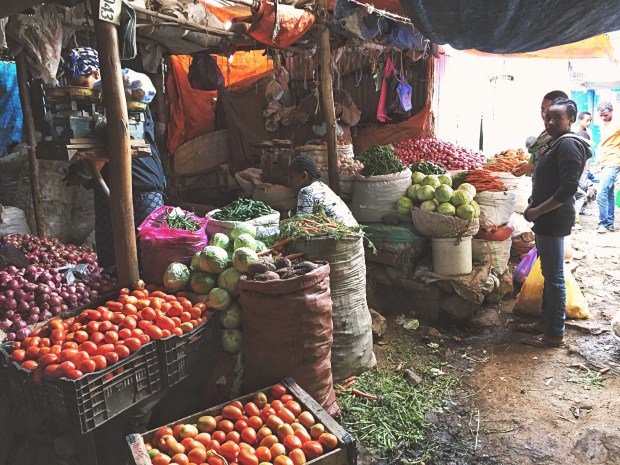
5 May. 06h43.
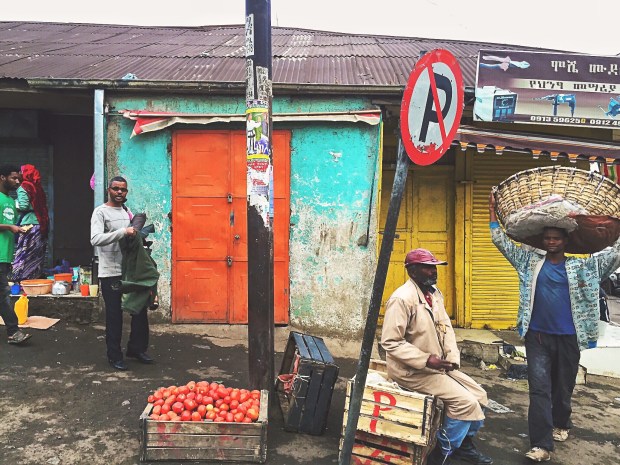
Limes, and jalapeños, and rotting mangoes, and dung. This smell is indescribable.
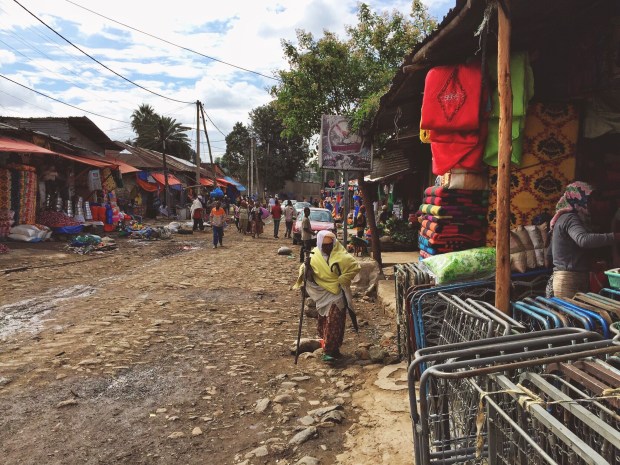
I shake my head at how ridiculous I was to think of putting on nice sandals, when solid boots are worth their weight in gold in this city. The light is dawn light but it is not pale and thin: there are too many people crushing, moving, shouting, clamouring. In the first five minutes of walking around the produce market I am nearly run over by a truck and narrowly dodge being clipped by a crate full of the tomatoes carried on top of someone’s head. I drink in everything around me like the eucalyptus trees that dot every hillside in Ethiopia – they call them yebaḥiri zafi, or sea trees, in Amharic, whether for their dusty aqua-coloured leaves or because they drink enough water to fill an ocean I do not know.
My camera slips so easily into my hands here. I want to catch everything but there is so much that won’t fit in my frame: the delicate smokiness from the heaping sacks of dark red berbere, the green truck overflowing with green bananas, the shouts of laughter between vendors – The light, most of all, and the way it slants over faces. The assault of smells.
8 May. 13h19.
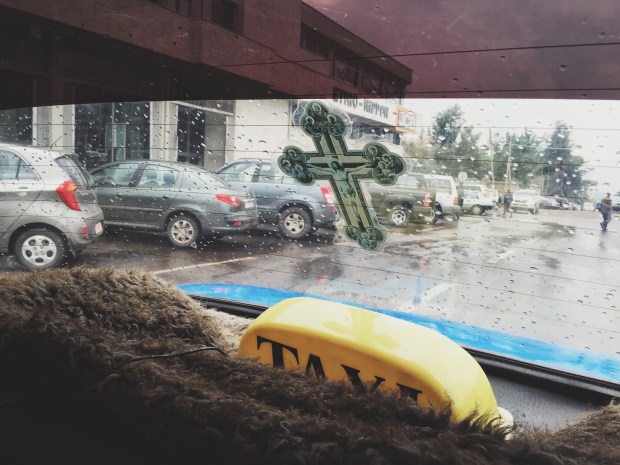
When he asked, we told him that none of us had a religion. I was in the front seat and I watched his face for his reaction when we answered, and to his credit he only pursed his lips a little, raised his eyebrows a fraction, and then shrugged uncomprehendingly. Every cabby in Addis plasters their windows with motifs of the Virgin Mary in her blue hood, hands folded and sunbeams blazing, or Jesus with his thorny crown; around their necks they hang soapstone crosses and we always knew when we were passing a church, because they would take a hand off the wheel to cross themselves three times. Ethiopians are proud of the way Muslims and Christians live so peacefully side by side in this country, one of the cabbies told us. We have never had problems like you see in other countries – we are all brothers.
They were accepting of our total lack of faith in the Father, Son and Holy Ghost but they could not comprehend that a white girl, a Chinese girl and a black girl were all from the same country. They looked at me and smiled when I said I was from Canada, then they turned to my friends and said, really? They chuckled. Really? Really, I said, a little fiercely. I am no more or less Canadian than they are. They shook their heads and chuckled again.
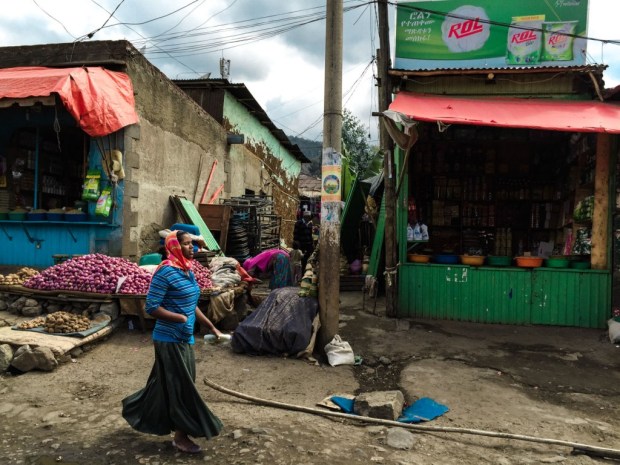
10 May. 17h32.
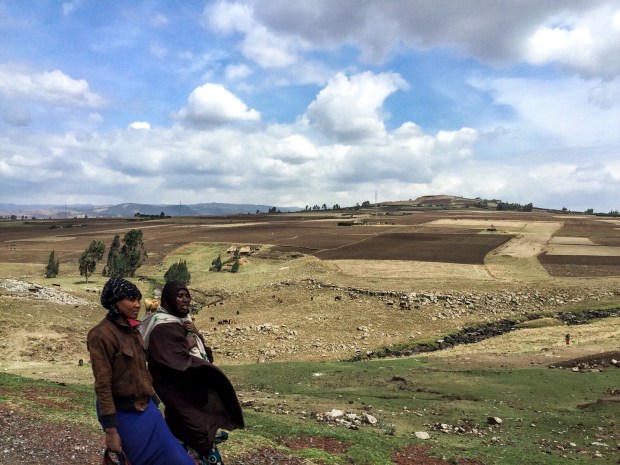
The city ends abruptly: we take a sharp turn onto the expressway and suddenly the shanty boroughs widen into farmland and the bus begins to swerve unnervingly around petulant cows standing in the middle of the highway. We breathe in the air which is so sweet on our lungs and out the black dust that permeates everything in the city below. In and out, in and out, I swear you can taste the juniper trees and the sunlight on your tongue.
And I am happy. Oh, I’m happy. I haven’t been this happy in such an awfully long time – I curl up in the back seat of the bus, I throw open the window, I hang my head out and the wind picks up my hair and tosses it around and I can feel my heart tugging behind me like a kite on a string, dancing in the breeze. These are the things I cannot photograph and these are the moments I can’t keep in a frame! Strands of hair trailing across lazy hazy grey-green humps of mountains in the distance, the old woman’s wrinkles as she peers out from beneath her white linen headscarf, the village we fly through which lines its streets with greenhouses and the woman’s blue and orange patterned skirt pinned in a doorway against all that green. When the joy is this swelling inside of you and it is overflowing onto your face and cracking your smile in two, and the sun and the wind are warm on your neck, you must simply shake your head, and laugh, and tell yourself, remember this. You must remember this.
11 May. 08h56.
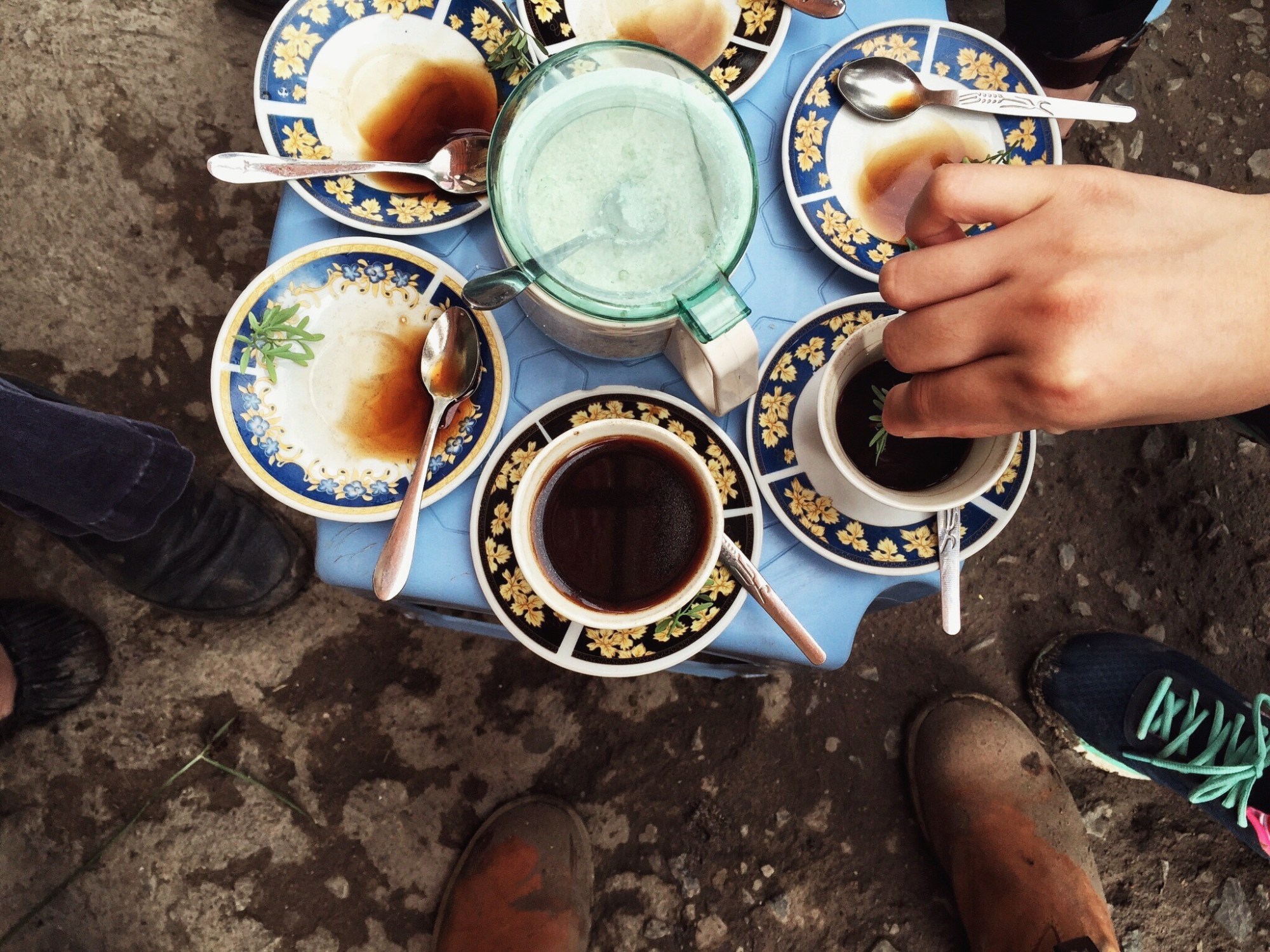
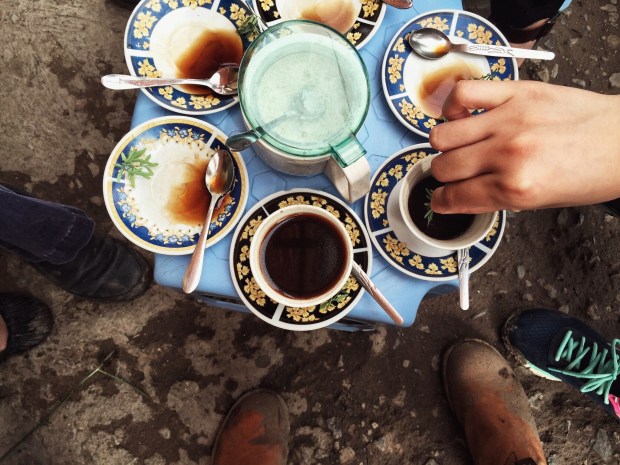
The macchiato costs twelve birr, which is roughly equivalent to seventy cents. It tastes like a million bucks. You can get lattes and cappuccinos and espressos but the only thing we ever drank were the macchiatos – espresso with a splash of milk and a lump of sugar. Most of the coffee is exported but the two lowest grades of coffee are kept in the country: they fill your mouth with a smoky kind of nuttiness, a smoothness and, if it is roasted with care by someone knowledgeable, a hint of chocolate. In Ethiopia the coffee shops range from To.Mo.Ca, which is the oldest and the most famous, to the tiny roadside stands characterized by an orange tarpaulin thrown over low-lying stools with the tiny brazier in the back upon which sits one of the little round-bellied black coffee pots and a smouldering crock of incense. There is no distinction in the process between these. If you sit down for coffee, on a tray they bring you the cup, the saucer, the little spoon and the sugar; they set the incense down on the table until the smoke wafts around you in long and languorous trails, and then the coffee steams forth from the elegant spout. The best coffee I had was in a shack down the road from our hotel, where they gave us sprigs of rue – a herb that tastes a little bit like thyme – to stir the coffee, and lend it a strangely floral note.
19 May. 16h23.
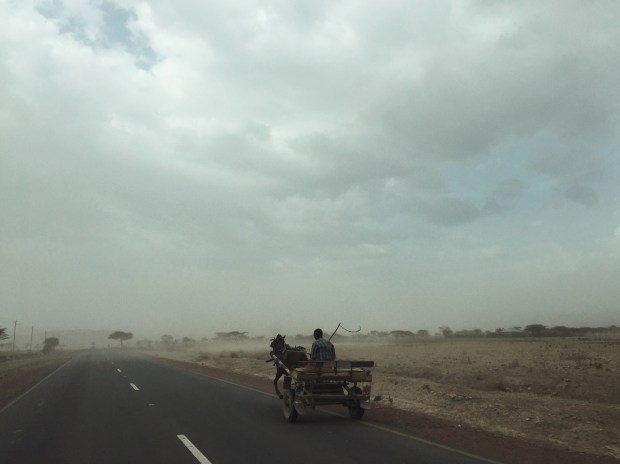
Even in the dust storm Yimer, the driver, didn’t close his window. He liked the fresh air, he said. You could see the dust storm coming a mile away – more than that, really, because the roads in Ethiopia change from corkscrew turns to long and true arrows in the space of a few metres. The part of the country outside of Addis is a dust basin in the dry season. Everything is turned the same kind of taupe as the smog, and the air felt heavy in my lungs long before we reached the city.
When you drive through the countryside it is hard to believe that this is the same country as the capital city. In the capital it feels like they are trying to leave behind the ancient roots: there are movie theatres (well, one movie theatre), and restaurants, and bars, and clubs, and a university, and a museum – If the houses are still made of tin and mud and the shops still covered by tarpaulins against the rain, then the people are well dressed and you can tell the city is developing. You can feel the push forward, the incessant thrust of progress, of the future.
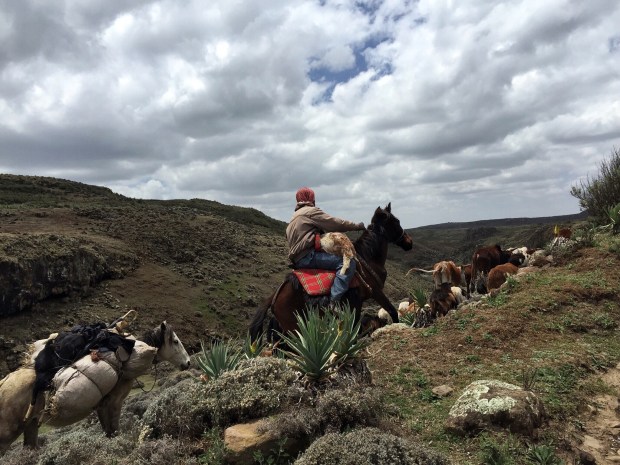
Then you drive for half an hour or so, and you are in a different world. There is a concrete factory that you pass and then you turn a corner beside an overpass and after that you’re onto the expressway, cutting through the low-lying farmlands, and it’s a wrinkle in time. The dust storm wraps itself around horse-pulled cabs and donkeys carrying bushels of sticks on their backs much more often than it does cars or trucks; if the people sitting behind the horses weren’t holding Nokia cellphones you would not be blamed for thinking this was a hundred years earlier.
20 May. 13h39.
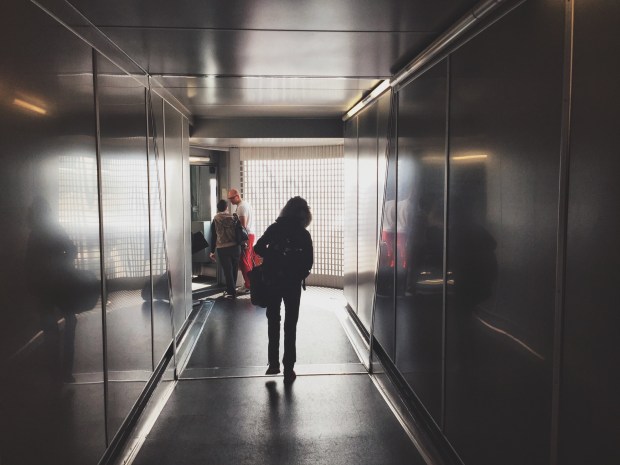
The light at the end of the tunnel is the loophole back to black and white and every time I move towards it my heart sinks a little lower and my feet drag a little slower. I had no expectations when I arrived. I knew it would be like nothing I’ve seen so far, and I was not wrong. Ethiopia was filthy and confusing and impenetrable and intense – And yet it gets under your skin. It is a different kind of thrill to be a part of something so dynamic, something so tremblingly new, something with so much potential and lust for life burning within it. The people tell me the city has changed in leaps and bounds just in the last five years: it is unrecognizable, and I believe them. The first time we went to the UN compound we saw the barest bones of a ten-storey building being constructed across the street; when we returned two weeks later the walls were up and they were beginning to pull together the outside.
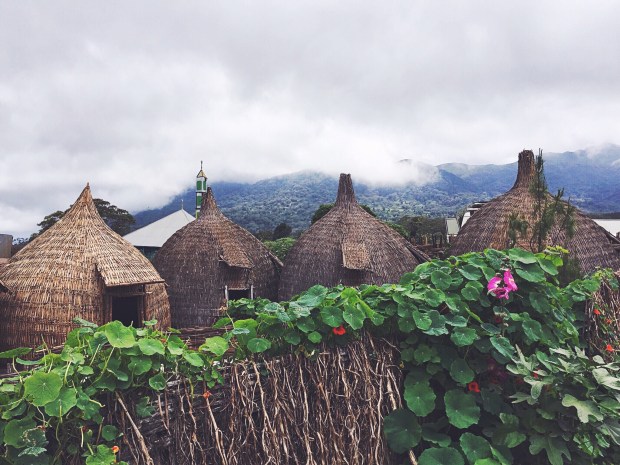
Ethiopia – or at least the Ethiopia that I have seen – is a land of contrasts. Desert changes to lush and rolling farmlands as quick as a town flashes by; the poorest of dirt poor live in squalor and shanties next to the opulent mansions of the nouveau riche. The flowers that tumble over gates and stone walls are striking magentas and creams and fiery corals and they careen into disintegrating roads and walkways, onto clots of unemployed young men and scavenger dogs – everywhere, everywhere, there are the stray dogs. The contrasts in this country are stark and universal, but so is the acute awareness of the partnership, the friendship, between the land and the people, forged over millennia of coexistence: it feels different, here. The taste of berbere on my tongue takes away the tang of airplane air, the tang of all the stones I’ve left unturned.
 Letters From ____